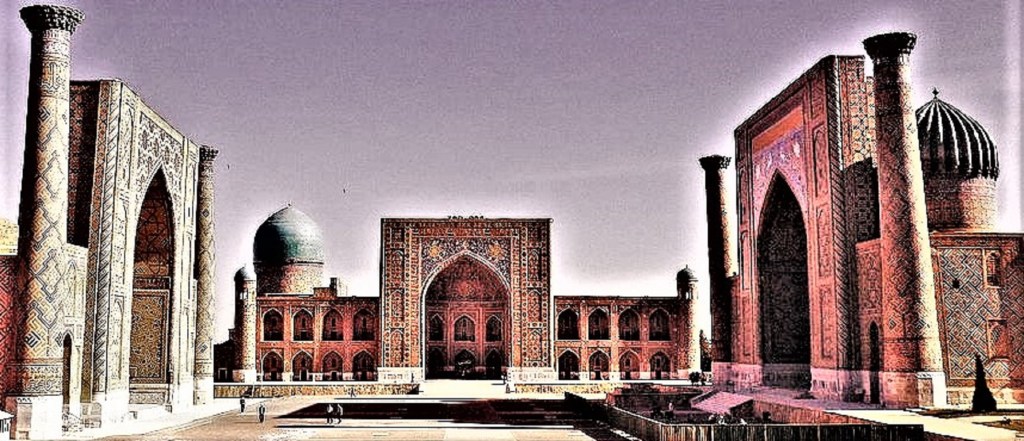
Nestled in the heart of Central Asia, the Republic of Uzbekistan is a land of ancient civilizations, vibrant traditions, and breathtaking landscapes. Spanning centuries of history, this diverse country has witnessed the rise and fall of empires, the crossroads of the Silk Road, and the convergence of cultures that have shaped its unique identity.
Prehistoric Origins and Early Civilizations
The earliest evidence of human habitation in what is now Uzbekistan dates back to the Paleolithic era, approximately 50,000 years ago. The region’s favourable climate and fertile lands attracted ancient settlers, who left behind cave paintings and tools as testaments to their existence. Over time, various nomadic tribes and agricultural communities flourished in the region, laying the foundations for future civilizations.
One of the earliest urban centres in Uzbekistan emerged around the 4th century BCE in the fertile Ferghana Valley. Known as the city of Akhsikent, it became a hub for trade and cultural exchange, connecting Central Asia with the wider world. However, it was during the first millennium BCE that the region truly began to thrive with the emergence of the mighty cities of Samarkand, Bukhara, and Khiva.
The Silk Road and the Age of Empires
During the 2nd century BCE, Uzbekistan’s strategic location at the crossroads of the Silk Road became a catalyst for cultural and economic exchanges between East and West. The Silk Road, a network of ancient trade routes, brought merchants, scholars, and travelers from China, India, Persia, and Europe to Uzbekistan’s flourishing cities. This influx of diverse cultures enriched the region, leaving an indelible mark on its art, architecture, and way of life.
In the 8th century CE, the Arab conquest of Central Asia brought Islam to Uzbekistan. In the early 8th century, the Umayyad Caliphate, led by Caliph Umar ibn Abdulaziz, sought to expand its dominion beyond the Arabian Peninsula. Central Asia, with its strategic location along the Silk Road and its prosperous cities, became a target for conquest. The Arab armies, bolstered by the zeal of their faith and military prowess, embarked on a series of campaigns to bring the region under Islamic rule.
The initial Arab incursions into Central Asia occurred in the late 7th century, but it was during the reign of Caliph Al-Walid I (705-715 CE) that significant progress was made. Under the leadership of General Qutayba ibn Muslim, the Arab forces gradually overcame local resistance and established their authority in major cities, including Samarkand and Bukhara. These conquests paved the way for the spread of Islam and the integration of Arab and local cultures.
The Arab conquest of Central Asia had far-reaching consequences. It facilitated the dissemination of Islamic teachings, leading to the conversion of many Central Asians to Islam. The new religion brought with it a new legal system, administrative structures, and architectural styles, which left a lasting impact on the region’s culture and society.
Despite Arab dominance, local Central Asian dynasties, such as the Samanids, managed to assert their autonomy and establish prosperous kingdoms. The Samanid Empire, which emerged in the 9th century, marked a significant period of cultural and intellectual revival. Under the patronage of the Samanid rulers, Central Asia experienced a golden age of art, literature, and scholarship. The cities of Bukhara and Samarkand became renowned centers of learning and attracted scholars from far and wide.
Mongol Conquests and Timurid Dynasty
In the 13th century, Central Asia witnessed another pivotal event in its history—the invasion of the Mongols led by Genghis Khan. The Mongol Empire, one of the largest empires in history, swept across Asia, including Central Asia, leaving a trail of destruction in its wake. The Mongols, known for their military might and nomadic lifestyle, brought an end to the flourishing cities of Central Asia and devastated the region’s infrastructure.
However, amidst the chaos, Central Asia experienced a resurgence under the Timurid dynasty. Timur, commonly known as Tamerlane, rose to power in the 14th century and established an empire that stretched from Anatolia to India. Despite his brutal military campaigns, Timur also patronized the arts and sciences, transforming Samarkand into a magnificent capital and cultural centre. The Timurid dynasty left a lasting legacy of grand architecture, intricate craftsmanship, and a fusion of Islamic and Central Asian aesthetics.
Colonial Era and Soviet Rule
The 19th century marked the onset of European colonialism in Central Asia, with the Russian Empire expanding its influence into the region. Russian forces gradually annexed Central Asian territories, including present-day Uzbekistan, and brought them under imperial control. The colonial period witnessed significant social and economic changes as the Russian administration introduced modern infrastructure, education systems, and industries.
Following the Bolshevik Revolution in Russia in 1917, Uzbekistan, along with the other Central Asian territories, found itself in a state of political flux. The collapse of the Russian Empire created an opportunity for national aspirations to take root, leading to the establishment of the Uzbek Soviet Socialist Republic (Uzbek SSR) in 1924. Initially, the new Soviet government implemented policies aimed at modernizing the region’s economy, including the collectivization of agriculture and industrialization.
During the early years of Soviet rule, Uzbekistan witnessed significant social and cultural changes. Educational institutions were established, literacy rates improved, and women’s rights were promoted. The Uzbek language, previously written in an Arabic script, was transitioned to the Latin alphabet in the 1920s and later to the Cyrillic script in the 1940s, further aligning the republic with Soviet policies.
However, the period also saw challenges, as the central Soviet government imposed heavy-handed policies and suppressed expressions of national identity. Uzbek intellectuals and cultural figures faced censorship and persecution, with efforts made to align the region’s culture with Soviet ideals. Nevertheless, despite these pressures, Uzbekistan managed to preserve elements of its rich heritage and continued to maintain its distinct cultural identity.
World War II and Post-War Reconstruction
During World War II, Uzbekistan played a vital role in the Soviet Union’s war effort. The republic became a safe haven for industries evacuated from war zones, with Tashkent becoming a key center for manufacturing and military production. Uzbekistan also provided refuge for evacuees and displaced people, including scientists, artists, and intellectuals, who enriched the cultural landscape of the region.
The war’s aftermath brought about a period of post-war reconstruction and industrial development. Uzbekistan’s natural resources, particularly its vast reserves of natural gas and cotton production, became crucial components of the Soviet economy. The republic experienced a significant influx of labor migrants from other parts of the Soviet Union, contributing to the multicultural fabric of Uzbekistan.
Political Changes and Independence
The late 1980s and early 1990s marked a period of profound political change throughout the Soviet Union, and Uzbekistan was no exception. As calls for greater political openness and national autonomy grew louder, the Uzbek SSR witnessed a surge in nationalist sentiments and demands for independence.
In 1991, following a referendum, Uzbekistan declared its independence from the Soviet Union. Islam Karimov, previously the First Secretary of the Communist Party of Uzbekistan, became the President of the newly independent Republic of Uzbekistan. In the early years of independence, Uzbekistan faced the challenge of transitioning from a centrally planned economy to a market-oriented one while establishing new political structures.
Karimov’s presidency, which lasted until his death in 2016, saw a mixed record in terms of political freedoms and human rights. While some economic reforms were introduced, including the privatization of state-owned enterprises and the establishment of a stock market, Uzbekistan maintained a centralized political system. Critics raised concerns about limited political pluralism and the suppression of dissent.
Economic Development and International Engagement
In recent years, Uzbekistan has embarked on a path of economic liberalization and reforms under the leadership of President Shavkat Mirziyoyev, who came into office in 2016. The government has implemented measures to improve the business climate, attract foreign investment, and diversify the economy. Significant steps have been taken to reduce bureaucratic barriers, encourage entrepreneurship, and modernize sectors such as agriculture, tourism, and infrastructure.
Moreover, Uzbekistan has actively sought to strengthen its international relations and increase its regional cooperation. The country has participated in initiatives such as the Belt and Road Initiative, fostering closer ties with China and other countries in the region. Efforts have been made to improve relations with neighboring countries, resolve long-standing border disputes, and promote regional stability.
Cultural Renaissance and Tourism
In recent years, Uzbekistan has experienced a cultural renaissance, as efforts are made to revive and showcase the country’s rich heritage. The restoration of historical sites, including the Registan Square in Samarkand and the Ark Fortress in Bukhara, has contributed to the revival of traditional craftsmanship and the preservation of architectural marvels.
The tourism sector has also flourished, with Uzbekistan becoming an increasingly popular destination for travellers. The country’s rich history, stunning architecture, and warm hospitality attract visitors from around the world. Uzbekistan has worked to improve its tourism infrastructure, including the expansion of transportation networks and the development of hotel facilities.

 EAST AND WEST
Leave a comment