Israel and the US start “Major Combat Operations” Against Iran
The build-up had been going on for weeks. But in the end the attack came unexpected . In the early hours of 28 February 2026, the United States and Israel conducted coordinated air and missile strikes on targets inside Iran, including facilities in and around Tehran. The U.S. Department of Defense stated that the operation targeted sites linked to missile development and nuclear infrastructure. The Israeli government framed the action as a pre-emptive necessity against what it considers an existential threat.
Tehran condemned the attacks as aggression and declared its right to respond under international law. Within hours, Iranian forces launched missiles against Israeli territory and U.S. military installations in the Gulf. The Pentagon confirmed that several bases were targeted and emphasized that American forces would defend themselves and respond proportionately.
Article continues below
East and West. Independent newspaper. Online since 2016
To help up stay independent, please consider funding
Patreon: https://www.patreon.com/posts/east-and-west-151550389 (CLICK ON LINK TO DONATE)
Go Fund Me: https://www.gofundme.com/f/east-and-west-newspaper CLICK ON LINK TO DONATE)
Washington has argued that earlier diplomatic efforts to secure limits on Iran’s ballistic missile program and expanded nuclear verification had failed. Israeli officials stressed that the strikes were directed at military assets, not civilian infrastructure. Iranian authorities reiterated that their nuclear program is peaceful and portrayed the strikes as further evidence of Western hostility.
The Iranian supreme leader Ayatollah Khamenei was killed in the early hours of the attack. Can sustained air and missile campaigns produce regime change in a consolidated state like Iran? History suggests the answer is almost always a resounding no.
Air Power and the Limits of Political Coercion
Modern air power can destroy infrastructure, suppress air defenses, degrade command-and-control networks, and impose economic costs. What it cannot reliably do is dismantle a political order that retains control over its coercive institutions. Bombing can weaken a regime’s military capabilities. It rarely removes the regime itself.
In 1999, NATO bombed Serbia for 78 days during the Kosovo war. The campaign compelled Belgrade to withdraw from Kosovo, but it did not immediately topple Slobodan Milošević. His fall came later through domestic political mobilization. The bombing shaped conditions; it did not directly engineer regime collapse.
In 1991, the U.S.-led coalition expelled Iraqi forces from Kuwait through air and ground operations but left Saddam Hussein in power. The regime survived a massive military defeat because it retained control of internal security forces and successfully crushed domestic uprisings.
The structural pattern is consistent: regimes fall when internal pillars fracture — security services defect, elites split, or mass protest overwhelms coercive capacity. External bombardment alone rarely triggers that chain reaction in states with cohesive security institutions.
Iraq 2003: Regime Change Required Occupation — and Produced State Collapse
The 2003 invasion of Iraq illustrates the opposite extreme. The regime of Saddam Hussein did not collapse because of air strikes alone. It fell after a full-scale ground invasion by U.S. and coalition forces, followed by occupation.
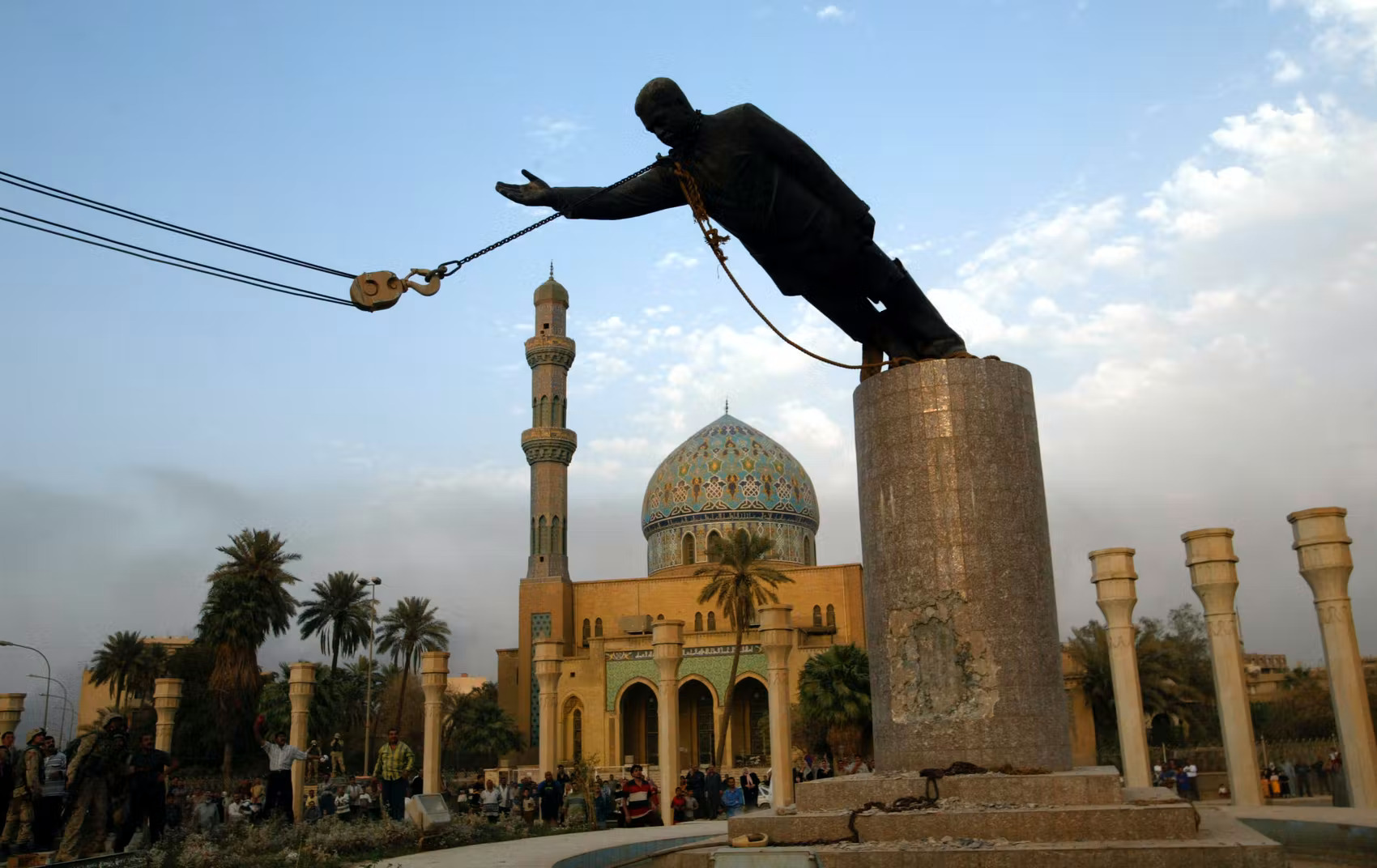
The Ba’athist state disintegrated not simply because it was bombed, but because foreign troops physically removed it from power. Ministries were seized. Command structures were dismantled. Leadership was captured or killed.
Yet regime removal did not translate into political stabilization. The dismantling of Iraqi security institutions and the de-Ba’athification policy hollowed out the state. What followed was insurgency, sectarian violence, and years of instability.
The lesson is not that ground invasions make regime change easy. It is that even when a regime is militarily defeated and territorially occupied, reconstructing political order is an entirely different and often uncontrollable process.
Afghanistan: Military Victory, Strategic Failure
The case of Afghanistan is also instructive. After the attacks of September 11, 2001, the United States launched military operations against the Taliban regime. Air power alone did not topple it. The fall of Kabul occurred only after U.S. special forces coordinated with Northern Alliance ground units.
The Taliban regime collapsed quickly once ground forces advanced. Yet two decades later, after prolonged occupation and state-building efforts, the Taliban returned to power following the U.S. withdrawal in 2021.
Afghanistan demonstrates a harsher truth: even when foreign troops overthrow a government and remain on the ground for twenty years, they may fail to transform the underlying political and social order. Military dominance does not automatically translate into durable political reconfiguration.
Regime change, even with boots on the ground, is extraordinarily difficult when external actors attempt to reshape internal legitimacy structures.
Iran’s Political Structure and Security Cohesion
Iran is not Afghanistan in 2001. Nor is it Iraq in 2003.
The Islamic Republic combines elected institutions — presidency and parliament — with clerical oversight bodies and a powerful security apparatus, particularly the Islamic Revolutionary Guard Corps (IRGC). The IRGC is not merely a military formation; it is embedded in the economy, intelligence structures, and regional networks.
Unlike regimes that relied primarily on narrow military elites, Iran’s system has developed layered internal control mechanisms. It has managed protests, sanctions pressure, and international isolation for decades. Its security institutions have experience operating under external threat.
External bombardment in such systems often consolidates, rather than fractures, elite cohesion. When foreign forces strike national territory, internal political competition frequently narrows. Even reformist factions become reluctant to appear aligned with external adversaries.
The assumption that air strikes will catalyze internal uprising rests on a fragile premise: that societal dissatisfaction automatically converts into regime collapse under pressure. Historical evidence suggests the opposite. External attack can transform political grievances into nationalist mobilization.
For regime change without ground forces to succeed, several conditions typically need to align simultaneously:
- Severe elite fragmentation within the ruling coalition.
- Security force defections or paralysis.
- Mass mobilization capable of overwhelming coercive capacity.
- External pressure calibrated to widen — not close — elite fractures.
Air campaigns tend to do the opposite of what is required. They incentivize elite solidarity. They increase the perceived cost of defection. They allow regimes to frame internal dissent as collaboration with foreign enemies.
Without territorial control, external actors cannot dismantle internal security networks. Without local allies capable of seizing and holding ground, air strikes remain coercive signals rather than transformative instruments.
And if ground invasion is introduced, the calculus changes from improbability to immense cost.
Geography and Demography
Iran’s scale matters. It is geographically vast, mountainous, and urbanized. Its population exceeds 85 million. Major cities are dense and politically significant. Any hypothetical ground invasion would require logistical capacity on a scale comparable to or exceeding Iraq 2003.
But unlike Iraq in 2003, Iran’s military institutions are not hollowed out by a decade of sanctions-induced attrition and no-fly zones. Nor is there a clear, unified exile opposition prepared to assume administrative control under foreign supervision.
Occupying Iran would not be a discrete military campaign; it would be a generational strategic commitment. The precedent of Afghanistan suggests how that ends.
Iran’s regional network — in Lebanon, Iraq, Syria, and Yemen — adds another variable. Sustained strikes on Iranian territory would likely trigger asymmetric responses across multiple theaters. That dynamic complicates escalation control.
Even if air campaigns degrade missile infrastructure, they do not eliminate proxy networks. Political transformation inside Iran would not automatically dissolve those connections. External military pressure might expand rather than reduce regional confrontation.
The Core Distinction: Degradation vs. Transformation
Military degradation is measurable: destroyed facilities, reduced missile stockpiles, damaged infrastructure.
Political transformation is qualitative: shifts in legitimacy, elite alignment, and internal power structures. The two are not equivalent.
Air campaigns can achieve degradation. They rarely achieve transformation. Ground invasions can remove regimes. They often unleash instability that outlasts the intervention itself.
If the objective of current operations is deterrence — to limit specific capabilities — then air strikes fit that framework. If the implicit goal extends toward regime change, historical precedent suggests that the probability of success without occupation is extremely low. And with occupation, the costs, duration, and unintended consequences multiply dramatically.
Afghanistan and Iraq do not offer abstract cautionary tales. They demonstrate that regime removal is not the same as regime replacement — and that political orders, once broken by external force, do not automatically reorganize into stable alternatives. Air power can destroy. It cannot govern. Armies that conquer often fail to reshape the political realities they inherit.
You can find the latest issue of East and West below. The next issue is due on March 7.

 EAST AND WEST
Leave a comment