
Europe and Ukraine think more pressure on Russia will force it to the negotiating table. This won’t work
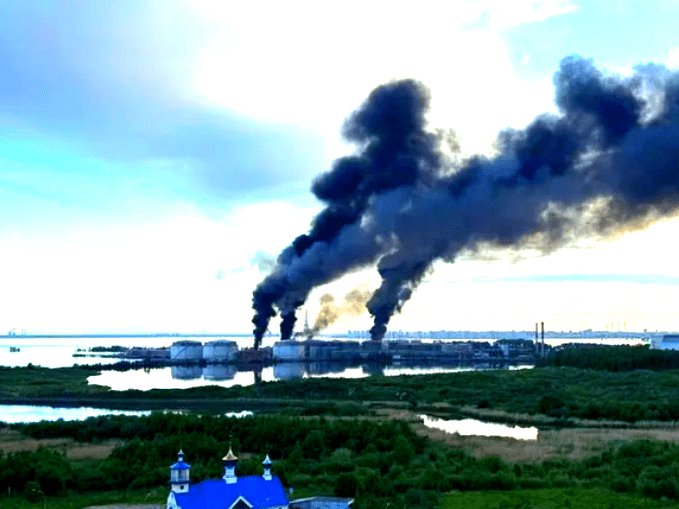
The belief that increasing strikes on Russian territory could shorten the war in Ukraine has become one of the central assumptions in parts of European and Ukrainian strategic thinking. The logic appears straightforward: if Russia is made vulnerable deep inside its own borders—if refineries burn, airbases are hit, logistics disrupted at scale—then political pressure inside Moscow will eventually force a recalculation and open the path to negotiations.
It is a coherent theory. It is also, so far, not supported by how the war has actually developed. What Ukrainian long-range strikes have demonstrated is not a collapse of Russian resilience, but a shift in the character of modern warfare. Cheap, mass-produced drones and long-range systems can now reach targets that were once considered safely beyond the battlefield. Russia’s vast territory, traditionally an element of strategic depth, has become more porous. This has real operational consequences: air defences are stretched, infrastructure must be dispersed, and energy facilities require constant protection. The psychological effect is also undeniable, as the war increasingly reaches areas far from the front line.
East and West. Independent newspaper. Online since 2016
To help up stay independent, please consider funding
Patreon: https://www.patreon.com/posts/east-and-west-151550389
(CLICK ON LINK TO DONATE)
Go Fund Me: https://www.gofundme.com/f/east-and-west-newspaper CLICK ON LINK TO DONATE)
You can find the latest issue of East and West below.
But there is a growing gap between tactical visibility and strategic effect. Strikes that dominate news cycles do not automatically translate into changes in the balance of power. The assumption that cumulative pressure inside Russia will eventually produce political rupture rests on a linear model of escalation that does not match the structure of the war.
Russia is not a system dependent on a small number of fragile points whose disruption would trigger broader collapse. It is a large, redundant military-industrial structure that has been progressively adapted to wartime conditions. Damage to individual facilities tends to be absorbed, rerouted, or compensated elsewhere. Even sustained attacks on energy infrastructure—while costly and disruptive—have not produced systemic paralysis of the Russian war effort. More importantly, the political effect of these strikes inside Russia does not point in the direction often assumed in Western debates. Rather than encouraging compromise, attacks on Russian territory are increasingly integrated into a domestic narrative of escalation with the West. The war is framed not primarily as a conflict with Ukraine alone, but as a broader confrontation in which Russia is already engaged with NATO-linked capabilities. In such a framing, pressure does not weaken resolve; it reinforces the perception that retreat would carry existential consequences.
The absence of immediate Russian “breakthrough responses” to earlier stages of escalation—such as expanded Western weapons deliveries or previous deep strikes—has often been interpreted as proof that further escalation will also remain contained. But restraint in one phase of a conflict is not a guarantee of restraint in the next. It may instead reflect calibration, not limitation.
At the same time, internal military assessments from the United States and NATO circles suggest that the broader balance of forces remains structurally stable. Despite tactical successes achieved by Ukraine—often enabled by Western intelligence and precision systems—Russia continues to retain advantages in mass, production capacity, and sustained firepower. Ukraine’s ability to conduct targeted operations does not remove the underlying asymmetry in attritional warfare.
This produces a contradiction at the heart of current strategy. On the surface, the war appears increasingly dynamic, shaped by dramatic long-range strikes and rapid technological adaptation. Underneath, however, the structural balance has proven remarkably resistant to change. Russia continues to conduct large-scale missile and drone campaigns, maintain pressure along the front, and sustain its military production. Ukraine continues to innovate and inflict damage, but without achieving the kind of breakthrough that would force a political settlement.
Industrial capacity is central to this dynamic. Russia has significantly expanded domestic production of artillery, drones, and missiles, adapting its economy to wartime demands despite sanctions. This does not mean sanctions are irrelevant, but it does mean they have not produced the kind of rapid systemic weakening that some early projections assumed. Meanwhile, Ukraine’s military effectiveness increasingly depends on external supply chains and technological integration, which—while highly sophisticated—cannot fully compensate for disparities in scale.
In this context, the idea that escalation inside Russia will produce a linear diplomatic outcome becomes increasingly difficult to sustain. The assumption is that pressure accumulates until a threshold is crossed and negotiation becomes the rational choice. But wars of attrition between large states rarely behave in such a way. Instead, pressure is often absorbed, adapted to, and incorporated into the logic of continued conflict.
There is also a deeper strategic risk embedded in this model. When strikes are interpreted primarily as signals rather than as tactical operations, escalation itself becomes semi-automated. Each new action is measured not only in military terms, but in its perceived political meaning. This creates a feedback loop in which visibility drives escalation logic more than material effect. In such an environment, restraint becomes harder to sustain, because absence of escalation is no longer neutral—it is interpreted as weakness or hesitation. Meanwhile, expectations of systemic collapse—whether economic, political, or military—have repeatedly failed to materialize on either side. Russia has not broken under sanctions or battlefield losses. Ukraine has not collapsed under sustained pressure or resource constraints. Instead, both have adapted into prolonged war economies in which endurance matters more than shock effects.

 EAST AND WEST
Leave a comment