
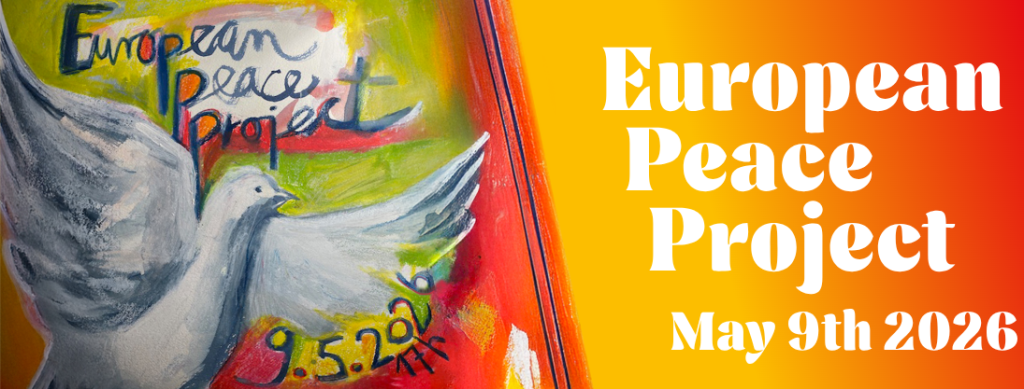
This year as well, the European Peace Project is taking place. On May 9, participants aim to take the future of Europe into their own hands through a “performative speech act” and to send a signal against the erosion of fundamental European principles such as peace, democracy, freedom, and mutual understanding between peoples. The European Peace Project was launched a year ago as an independent and decentralized art initiative opposing the rearmament and increasing militarization of Europe.
“Last year, we had 17,000 participants,” says Peter van Stigt, one of the organizers, in an interview with the Swiss blog Globalbridge. “We know there are many more Europeans who want peace, and we want to reach them and have 100,000 peace doves on our map. Last year, we received more than 800 photos and videos, and we created a gallery from them with hundreds of videos on our YouTube channel. We want more peace!”
The actions of the European Peace Project take place across Europe. Participants can register on the project’s website, after which their location will be marked on an interactive map. Anyone wishing to take part only needs to read aloud the text of the European Peace Project’s manifesto, wherever they are—whether on a balcony at home or in a public square. Participants can document the moment with photos or videos and send them to the organizers. After May 9, the submissions will be published in a digital gallery on the official website—as a visible sign that many citizens of Europe stand for peace rather than war.
The European Peace Project is an initiative of independent individuals from academia, the arts, and business—not an organization or NGO. Behind it lies solely the desire for sustainable peace, mutual understanding between peoples, dialogue, and the balancing of interests through addressing the root causes of conflict. The initiators are Ulrike Guérot, a renowned political scientist and publicist from Germany; Isabelle Casel, artist, activist, and founder of Peace Lab Europe; and Peter van Stigt, a committed entrepreneur from the Netherlands and a specialist journalist focusing on Eurasia. The manifesto and further information can be found on the European Peace Project’s website.
The European Union was originally conceived explicitly as a peace project. Peace was regarded as one of the great achievements of a united European community. Yet today, when EU leaders speak, war is all too often the subject. Only a few years ago, this would have been unthinkable. The European Union, which once emerged as the European Economic Community from the ruins of the Second World War and saw itself for decades as a guarantor of peace, now speaks of rearmament. It is constantly argued that we must prepare for war. Anyone who dares to oppose the relentless calls for military strengthening in the face of an allegedly unmistakable Russian threat is defamed as a “false pacifist,” “pro-Russian,” or even a “useful idiot of Putin.” Europe’s political elite today appears unwilling even to consider peaceful coexistence with Russia. Yet for many European citizens, peace remains the most important priority. Europe and Russia do not have to be condemned to a civilizational confrontation.


Leave a Reply