
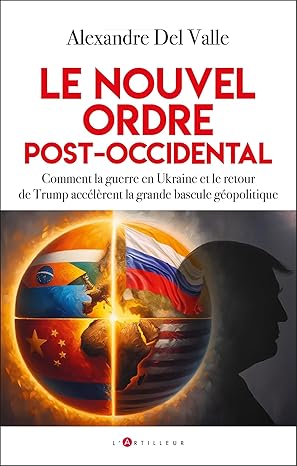
Alexandre Del Valle is a prominent French geopolitical analyst. He is the author of numerous books; his latest is “Le Nouvel Ordre Post-Occidental: Comment la guerre en Ukraine et le retour de Trump accélèrent la grande bascule géopolitiquel”, or “The New Post-Western World Order: How the War in Ukraine and Trump’s Return Are Accelerating the Great Geopolitical Shift”. East And West interviewed Alexandre Del Valle.
What was the Western world order, and how long did it last? Was it truly a global world order led by the West?
The Western world order took shape between 1945 and the 1950s, centred on the power of the United States, which emerged from the Second World War as the dominant player both militarily and economically. The establishment of NATO, the hegemony of the dollar and the creation of major international financial institutions (Bretton Woods, the IMF, the World Bank, etc.) formed the pillars of this system. During the Cold War, it was also defined by its opposition to the Soviet bloc, but it was after 1991, with the collapse of the USSR, that it took on a fully unipolar form. From this “unipolar moment” onwards, when Fukuyama prophesied the so-called “end of history”, the United States and the universalist-global Western system ceased to represent a Judeo-Christian or Euro-Christian civilisation, based on a distinct geography, ethnicity, Greek philosophy, Roman law and Christian personalism, but became an uprooted cosmopolitan project founded on the destruction of identities, on an anti-civilisational globalist utopia, and on Atlanticism and institutions and multinationals controlled primarily by America.
Since then, this Western-Anglo-Saxon order has given the impression of being global, because the Anglo-American elites and their followers in continental Old Europe led people to believe that (neutral) technological globalism signified the end of sovereign nations and identities and was synonymous with “political mondialism”, that is, it would necessarily lead to an internationalist globalist project that would one day become a sort of world empire with planetary “governance”, falsely presented by the Anglo-Saxon elites as the End of History and of Wars and the victory of progressive liberalism. In reality, it was a profoundly Western-centric order, directed by America and its Anglo-Saxon partners in collaboration with major American multinationals, against a backdrop of massive offshoring and the financialisation of economies. Its universality was more proclaimed than real, and the cosmopolitanism constantly extolled and conveyed by the slogans and songs of pop culture or Hollywood films (“We Are the World”), merely concealed a hegemonic American neo-imperial-globalist project, of which the Liberal International Order (“LIO”, often described as “rule-based”), conceived by John Ikenberry and constantly championed by the Neocons and US Democrats, served as the moral and political justification. But in the meantime, countries such as China and India have managed to integrate economically into the neutral, economic-industrial dimension of this globalisation without ever becoming “globalists” and without becoming perpetual “world factories” at the service of multinationals and Western industries recklessly relocated to Asia, but rather with the aim of one day surpassing the former white-Western rulers themselves. They have used globalisation not to become, like the “European fool”, a “de-sovereignised” and “de-civilised” zone, but rather to build and strengthen their national independence and, at times, to revive their historical imperial claims through a conservative and cultural assertion of identity that is entirely opposed to Western progressive liberalism and the LIO. These new industrial and geopolitical powers have refused to adopt the Western political principles of the LIO, whilst Russia, after a brief phase of pro-Western openness (quickly dashed by NATO and EU enlargement towards the East), has progressively rejected integration into the Western system since 2003 (the Iraq War and anti-Russian colour revolutions).
One can therefore speak, at least in part, of a form of strategic myopia: the West has confused its own hegemony with a universal vocation, underestimating the resilience of other civilisations and the possibility of a return to competition between great powers. It has utopianly and blindly conflated political globalism (which caused it to lower its guard regarding identity and rendered it civilisationally “apostate”) with economic and financial globalisation, which was anything but cosmopolitan or peaceful, but rather a realm of ultra-competition for power and mega-rivalry between states and empires, of which the least internally globalised are, paradoxically, the true winners of globalisation.
East and West. Independent newspaper. Online since 2016
To help up stay independent, please consider funding
Patreon: https://www.patreon.com/posts/east-and-west-151550389
(CLICK ON LINK TO DONATE)
Go Fund Me: https://www.gofundme.com/f/east-and-west-newspaper CLICK ON LINK TO DONATE).
What does “post-Western world order” mean? Is it an inevitable process? Must a post-Western world order necessarily signify the decline of the West?
A post-Western world order does not imply the disappearance of the West, but the end of its normative and strategic monopoly. It signifies the emergence of a multipolar, polycentric, plurinormative system, in which various powers — China, India, Russia, but also regional actors such as Turkey or Iran — assert their own vision of the international order and, naturally, their own spheres of influence — something the universalist-globalist West has refused to accept since the 2000s, expanding its geostrategic, political-economic and financial institutions across the globe whilst encroaching upon the spheres of influence of its rivals, competitors and partners in the non-Western world.
This process of multipolarisation of the post-unipolar world appears difficult to reverse, and the Ukrainian crisis, which began metapolitically in 2005 and geopolitically in 2014 (Euromaidan), has been its main catalyst, triggering a war between the revisionist neo-imperial power least tied to globalisation, Russia, and the Atlanticist powers. But for Russia’s partners, particularly China, which also feels encircled and surrounded by American-Western powers to the west, south and on its eastern flank (the new “rimland”), the stakes are very high: it is an opportunity to attempt a global geostrategic “Grand Reset”, a new Yalta or “Helsinki 2”, which will aim to make the West accept, through negotiation or through escalating showdowns, a new distribution of global power hierarchies amongst the strongest, established, rising and outsider actors/empires. More broadly, beyond the “second group” — the anti-Western revisionist powers of Russia, China, Iran, North Korea and their allies — this new post-Western Order is the result of profound structural transformations within the “third group”: the powers of the so-called “Global South” such as India, or rather the non-Western world composed of very diverse realities, which I prefer to call “opportunistic multi-aligned powers”. These include India; Turkey; Indonesia; Gulf states such as the UAE and Saudi Arabia; key players in the SCO or BRICS; and the ongoing de-dollarisation process, which may have close ties, depending on the issue, with both Group 1 (the Western powers) and Group 2 (the anti-Western powers). Asia’s economic weight, the demographic growth of non-Western regions, and the spread of technological and military capabilities beyond the West also come into play, within the framework of what I describe in my book as an alternative, “de-Westernised” and “de-universalised” globalisation. The post-Western order is therefore less ideological and more pragmatic, founded on power relations and interests rather than on universalist values. And the powers I have mentioned, members of groups 2 or 3, unlike the naive and morally rigid Europeans, do not favour binding alliances. For them, Article 5 does not exist. Pragmatism reigns. They cooperate; but they are not prisoners of military alliances. This explains why those who regard the Sunni anti-Assad revolution in Syria, the capture of Maduro in Venezuela, or the Israeli-US war against Iran as “defeats” for the Russians and the Chinese are mistaken. Things are far more complex, and the reactions of Group Two are neither symmetrical nor immediate. But de-dollarisation, the de-Westernisation and de-universalisation of the World System (a more realistic concept than Aron’s notions of the World Order) is underway, and it is almost impossible to halt this process, not even with a world war that America cannot win against the Russian-Chinese-North Korean anti-Western axis, which may seem less powerful but possesses not qualitative but quantitative superiority. And in wars, the mass production of ammunition and missiles and the mobilisation of soldiers is decisive. The West remains superior in certain sectors, but has committed the grave error of financing, globalising and deindustrialising its now weak economies, which no longer control the production and supply chains of rare earths and the most strategic resources, and which no longer hold a monopoly on scientific and technological innovation, nor even on communication routes.
Talking about decline can be misleading if understood in absolute terms. The American West continues to hold a significant advantage in key areas: technological innovation, apps, AI, military capability and cultural influence (soft power), but it no longer has a monopoly on these, and is about to be overtaken by China, and tomorrow by India, the two giants of the future, not to mention the other emerging powers of Asia and Eurasia. North America’s economic appeal still exists, but Old Europe seems to be fading from history. The United States remains the leading global power, and Europe retains considerable economic clout, but the welfare state, the continent’s falling birth rate, Europe’s self-contempt, its division, and its pathological dependence on the United States — despite being insulted, mistreated and taxed (the anti-European tariff war launched by Trump) — remains absolute, through a “global NATO” and through the price of gas being four times higher than in America. The West is experiencing a dual division: between North America and the European Union, on the one hand, and between sovereigntists and globalists in every Western country, on the other. Finally, whilst America has deindustrialised, it remains an empire with the world’s most powerful military and a defence budget exceeding that of all other nations; it remains the largest producer of apps and protects its market in certain sensitive strategic sectors (“Buy American Act”, IRA, etc.), whilst do-gooder Europe does not spend enough on R&D and innovation, and lacks both a diplomacy and an autonomous defence capable of making an impact, let alone the capacity to act as a state — a state it fails to be and cannot become for profound and varied reasons. What is actually taking place is rather a relative decline of America and a strong one of Europe, which is on the path to the “self-erasure” of civilisation, as defined by the US National Security Strategy on 4 December 2025. The West is not necessarily losing power, particularly the US, but others are gaining significantly, from a demographic perspective (Westerners have gone from 25% to 8% of the world’s population in a century). This global dynamic — industrial, geopolitical (BRICS, SCO, etc.), financial (de-dollarisation), demographic and civilisational (the assertion of identity and strategic power by other nations whilst a large part of the Western elite is self-destructing in civilisational terms) — is permanently altering the balance of power without implying an immediate collapse. But the decline of Europe, overwhelmed by immigrationism and do-goodism, and thus lacking a “will to power” — unlike the other players — is undeniable.
Would a post-Western world order necessarily be anti-Western? What would be the West’s place in such a world order?
I believe that a post-Western world such as the one described in my essay is not necessarily anti-Western; quite the contrary. The book’s main argument is that the globalised West of our ruling elites, with the exception of a few isolated cases such as Orbán, Meloni, Fico, and of course Trump in America, is the antithesis and indeed the enemy of the “rooted” West. What both Western sovereignists and former colonies hate — or even China, Russia, Modi’s India or Erdogan’s Turkey —, is not the fact that Europe has its own religion and its historical Christian-Celtic-Germanic-Greco-Latin identity, but the fact that it is universalist, neo-imperialist, proselytising and anti-traditional, that is, that it always seeks to extend its liberal-progressive values, customs and political systems throughout the world. What the so-called “Global South” hates is not the desire of European peoples to remain nations and preserve their traditions, rather, it is the fact that the globalist West of the LIO (which American realist strategists call “liberal hegemony”) has become a vast machine for the deconstruction, destruction and dismantling of the sovereignty, identity, values and traditions of peoples. The best example is provided by Viktor Orbán, who, whilst not wanting Muslim migrants in his country but being a multipolarist and nationalist, maintains the most cordial relations with Erdogan’s Turkey, which he holds in much higher regard than Trump and Orbán do all other Western leaders. Another example is provided by Prime Minister Giorgia Meloni, who is viewed far more favourably across Africa, in Arab countries, and even in Turkey, Brazil and Pakistan than any other European leader. Many international actors do not seek to oppose the West head-on, but rather to reduce its globalist-proselytising influence, its political interference and economic-ideological pressures, and to assert their own autonomy within a multipolar world that European nations can accept without danger, because the end of globalist-liberal interference and arrogance will be perceived as a new path towards win-win relationships between non-aligned and autonomous powers. I should point out that many anti-unilateralist countries are not anti-Western in the geo-civilisational sense, but are anti-globalist and non-aligned or multi-aligned, not bound by coercive collective alliance systems such as our NATO, whose eastward expansion is one of the sources of the terrible civil war pitting two fraternal Slavic peoples against one another (Ukraine-Russia). Countries such as India or Brazil adopt strategies of balance, of “multi-alignment”, maintaining relations with both the West and other powers. If we are not aligned with the expansionist, woke, liberal arrogance of the globalist elites, they see us as respectable partners and have nothing against our civilisation; quite the contrary. In this context, the West remains a central pole, but no longer a dominant one, which will only survive if it renounces its universal-globalist proselytism. It will have to adapt to a logic of coexistence and competition, accepting that its values are no longer universally shared and that other models can coexist.
Has the war in Ukraine strengthened the BRICS countries? Why, paradoxically, does the West appear to be more united in its support for Ukraine, whilst the BRICS remain divided?
The war in Ukraine has strengthened the countries of the BRICS group (which has since become BRICS+, expanded to include five additional full members and around fifty observers, friends and candidates), particularly in geopolitical, economic-financial and political terms. They are increasingly presenting themselves as an alternative to the Western globalist and Atlanticist order, and thus to the LIO and Anglo-American global hegemony, for example by promoting the use of local currencies in international trade and opposing unilateral sanctions. However, this apparent cohesion masks deep divisions and differences. The BRICS+ group is not a “counter-NATO” or a geostrategic alliance, but rather a multipolar, plurinormative, polycentric global forum in which states — not always friends or allies — come together to build a new global economic and geopolitical system no longer bound to conform to the old liberal order conceived and controlled by the Americans and their allies. The BRICS bring together countries that are sometimes even strategic and military enemies, such as India and China, but which have an interest in cooperating economically and in building a non-Euro-American-centred order. This forum is not a binding political-military alliance like NATO: China, for example, maintains a cautious stance, avoiding direct military support for Russia so as not to jeopardise its global economic interests, whilst helping Russia to circumvent sanctions and counter the NATO blockade. And it takes advantage of discounts on Russian crude oil and gas that Europeans no longer wish to buy. India, for its part, has exploited the situation to purchase Russian energy at low cost, without severing ties with the West, whilst selling Europe refined petroleum products at high prices but based on Russian oil bought at discounted rates. Tensions between China and India, which had already emerged in the 2020 clashes along the Himalayan border, demonstrate the absence of any real strategic unity. The BRICS+ is an organisation of multi-aligned and pragmatic states. This highlights that the post-Western world is no longer divided into rigid blocs, but into fluid and variable configurations. But I do not think the Western bloc appears more united than ever: Donald Trump’s threats to abandon NATO, the US tariff war against European Union countries, divisions over the war against Iran and the refusal by Europeans to participate in the war launched by the US and Israel or even to intervene militarily to secure navigation in the Strait of Hormuz, and the increasingly strong opposition between Trumpian or JD Vance-style imperial neo-nationalism and the -do-gooder-federalism of old Western Europe demonstrate a growing intra-European divide that could intensify if and when British, Spanish, German, Portuguese or French sovereigntists (backed by Washington) come to power and strengthen the pro-Russian Hungarian-Slovak bloc. In the book, I explain first of all that the notion of the “West” — reinforced during the Cold War and during the post-Soviet “unipolar moment” of the 1990s and 2000s, when the US became unilateralist and had no rival — is largely an artificial construct. Secondly, I explain that the divisions between the US and the EU on the one hand, and within all Western countries torn between do-gooder globalism and anti-globalist sovereignty, constitute an unprecedented rift that is weakening all these countries as never before, with some even at risk of civil war, such as France or Britain. Furthermore, the war in Ukraine, just like the war in Iran, has forced the West to concentrate vast stocks of missiles, ammunition, artillery, aircraft, radar systems, etc., which will be in short supply for Asia and the “Indo-Pacific” pivot zone, where Xi Jinping’s China, America’s true systemic and strategic adversary, will soon be able to definitively seize the island and the Taiwan Strait. The war in Ukraine has shown that the ultra-financialised and deindustrialised Western countries are at the cutting edge of technology, but are unable to mass-produce the weapons, ammunition, drones, missiles and anti-missile systems needed to win a high-intensity, protracted war. And they have demonstrated that their elites have neither a common nor a long-term strategy. Finally, the war in Ukraine has shown that the 32 NATO countries and all the weapon systems of the wealthy Western nations have failed to enable their Ukrainian ally to regain either Crimea or the Russian-occupied parts of the Donbass and “Novorossiya”. What appeared to be a Western “victory” will be seen in history as a defeat if Russia manages to secure a peace treaty or a negotiated status quo directly with Washington, behind the backs of the European “fools”, who pay for weapons purchased — and no longer supplied — by the Americans and take the risk of handing them over to the Ukrainians. Trump’s strategy consists of “offshore balancing”, a concept of American realists based on “balancing from a distance”, that is, allowing middle powers to compete and act amongst themselves, delegating to some the burden of imperial responsibilities, and no longer intervening directly except when necessary. Trump adds to this the fact that the Europeans must assume the risk of all-out war with Moscow, and if they want soft, indirect American support, it must be in exchange for buying more weapons from America, more shale gas, and spend 5% of their GDP on defence, with no future promise to honour NATO’s Article 5 in the event of an invasion or a new Russian attack against a NATO or EU country. This is hardly cohesion and a strengthening of the West as a result of the war in Ukraine; quite the contrary.
Is it possible for the transition to a post-Western world order to take place without a world war? Does the so-called “Thucydides Trap” really exist?
Historically, shifts in hegemony have often been accompanied by major conflicts and world wars. The Thucydides Trap theory suggests that rivalry between an emerging power and a dominant one may lead to war. In “Destined for War”, Graham Allison argues that when an emerging power challenges a dominant power, a very dangerous structural tension is created, which often leads to war. Allison analyses 16 historical cases using Thucydides’ method: 12 resulted in war, 4 were avoided (e.g. the management of the rivalry between the United States and the Soviet Union during the Cold War). Obviously, the modern debate concerns the United States (the dominant power) and China (the emerging power). Allison warns that the rivalry is multifaceted — economic, technological and military — that strategic misunderstandings are growing, and that local crises such as Taiwan could trigger a conflict, even if neither side desires it. This is the trap: no one wants a global war, but the mechanisms and structural-technological spirals lead us to fall into it. The Thucydides Trap theory does NOT say that war is inevitable, but that the risk increases dramatically and that very careful political management is therefore needed to avoid it.
Today, of course, nuclear deterrence makes direct conflict between major powers extremely risky, whilst economic interdependence creates incentives for stability. It is therefore plausible that the transition will take place without a world war, but through prolonged competition consisting of regional crises, indirect conflicts and technological rivalries, as is already evident in the tensions between the United States and China. That said, I explain in my essay that the war in Ukraine has drastically and dangerously altered the perceptions and strategic doctrines inherited from the Cold War and the global balance of power of that era: Ukrainian President Zelensky, in his strategy of direct attacks against Russia, increasingly deep into its territory and against strategic targets (bombings/missiles and drones launched towards Russia to capture the Kursk Oblast in the summer of 2024, or against Russian strategic aircraft and nuclear bombers 5,000 km away in the summer of 2025), has demonstrated to the imprudent West that a country’s nuclear force does not guarantee “sanctity” if one dares to challenge it, because a nuclear military power will not dare to use nuclear weapons until it is existentially threatened, and because the nuclear weapon is a weapon of “non-use”. This almost religious conviction is extremely dangerous. Throughout the Cold War, US strategists never dared to challenge Russian spheres of influence with weapons within the borders of the USSR, and never allowed any actor to directly attack Russian territory, which was then “sanctified”. Since 2024, Russia has adapted to this dynamic and has changed its doctrine and its thresholds for the use of strategic and tactical nuclear weapons. Meanwhile, the latest nuclear non-proliferation and arms control treaty between the US and Russia, New START, has expired, meaning there are no longer any treaties, agreements or mutual trust between the two sides to maintain the certainty of the balance of terror and the conviction that neither side will use nuclear force. The fact that Ukraine struck Russian strategic aircraft capable of carrying nuclear missiles — which were visible in the name of transparency and the mutual verification processes between the US and Russia provided for by the Open Skies and New START treaties, both of which have expired — and the fact that Ukraine was able to do so using British and Western satellite imagery and radar data, and therefore with US approval, means that Russia no longer believes in any cooperation on mutual risk reduction with the American side. The situation and the risk of a mutual lowering of the threshold for the use of nuclear weapons, as a direct consequence of the fact that the West — not directly targeted by Russian aggression in Ukraine — has fully sided with the Ukrainians and acted there as a de facto co-belligerent, has made the risk of a nuclear confrontation more likely (albeit still unlikely) than ever before, and more likely than during the Cuban Missile Crisis itself.
Will a multipolar world order lead to more chaos and wars than the Western order?
The idea that the Western order has guaranteed peace for eighty years is incorrect; it is a narrative that is historically and geopolitically flawed. Whilst it is true that it prevented direct conflict between major powers during the Cold War and the early years of US unilateralism, it did not prevent numerous regional wars, from Korea to Vietnam and the Middle East, and the American hubris of Clinton, Bush Jr, Hillary Clinton-Obama, Biden and now Trump has made the world far more unstable because all the liberal values, the promotion of human rights, the LIO, the fine progressive and democratic ideals of Western countries have been discredited and contradicted by Anglo-American and Western wars waged in permanent violation of the rules of multilateralism, the UN Charter, and international law — that is, by the very “rules” of the liberal international order. This inconsistency and these betrayals of their own values by Western countries and unilateral America have prompted and fuelled a harsh, progressive and profound reaction from the Russian, Chinese and even Indian, Turkish and other “outsiders”, who now also want their own spheres of influence and their “share of the pie”, and so they too want a geopolitics of power relations and are relying on their new realities and capabilities to demand a new distribution of global power amongst the major powers, which are very different, less Western, and more numerous than when there were only the European colonisers and then the single, unilateral American empire. A multipolar world in the process of taking shape may appear more unstable because it is less predictable, but it may also prove more balanced, insofar as no single power is capable of unilaterally imposing its will, and insofar as negotiations can take place “between adults”, cool-headedly and pragmatically, the new redistribution of global powers and the new hierarchies within this post-Western world order or system. Everything will depend on the ability of international actors to establish shared rules, however minimal, to manage competition.
On what might a post-Western world order be based?
Unlike the Western order, founded on relatively clear pillars such as the dollar and American military supremacy, the post-Western order will likely be more fragmented and complex, but far more decentralised, “plurinormative”, pragmatic and “multiplex”, as conceived by the great Indian analyst Amitav Acharya. The renowned Indian Minister of External Affairs, Subrahmanyam Jaishankar, has developed a very interesting concept to define India’s national strategy: “multi-alignment” and “plurinormativism”. We are already witnessing attempts to reduce dependence on the dollar, the development of alternative financial systems and growing competition in the technological sphere. But it is not just about that. The new post-Western order can and will only be peaceful and stable if all actors are pragmatic and capable of thinking in terms of well-defined regional poles and spheres of influence, rather than as centres of global domination or globalist proselytism. Rather than a single hegemony, this new order will be based on a plurality of centres of power, flexible alliances and interdependent economic networks. In this sense, the emerging world is not so much a new stable order as a transitional phase characterised by uncertainty and continuous adaptation. Historically, shifts in hegemony have often been accompanied by major conflicts. Despite this, it can only lead to a new peaceful multipolar global system if the established American power has the wisdom to accept a redistribution of regional spheres of influence with competing and rising neo-imperial powers. Today, however, the context is different. Nuclear deterrence makes direct conflict between great powers extremely risky, whilst economic interdependence creates incentives for stability. It is therefore plausible that the transition will take place without a world war, but through prolonged competition consisting of regional crises, indirect conflicts and technological rivalries, as is already evident in the tensions between the United States and China.
In this sense, the emerging world is not so much a new stable order as a transitional phase characterised by uncertainty and continuous adaptation. We are in the phase I call “pre-Yalta” or pre-New Yalta. Either this new redistribution will take place according to indirect power dynamics, as is currently seen in Venezuela, Syria, Iran, Lebanon, the Gulf states, the Caucasus, the Balkans, Eastern and Central Europe, Greenland, Panama, Ukraine, etc., and the balance of power and the signing of the new Yalta will occur when all these rival actors have maximised their spheres of influence and their mutual “strategic depths” as far as possible where they can, and will pragmatically stop there, or they will fail to reach an understanding and be caught up in the machinery of total war, ending as on previous occasions in a world war. I believe Trump is rather in favour of the first possibility, as are China, Russia and India, but everything will change depending on who wins the next US presidential election: a true isolationist like J.D. Vance, capable of implementing the multipolarism that Trump promised but betrayed, or a new interventionist Democrat or a unilateralist neo-conservative “cowboy”. Only the future will tell, even if no one wants the second scenario; but world wars are always the result of mechanisms and cogs that can never be controlled and are almost never desired.


Leave a Reply