
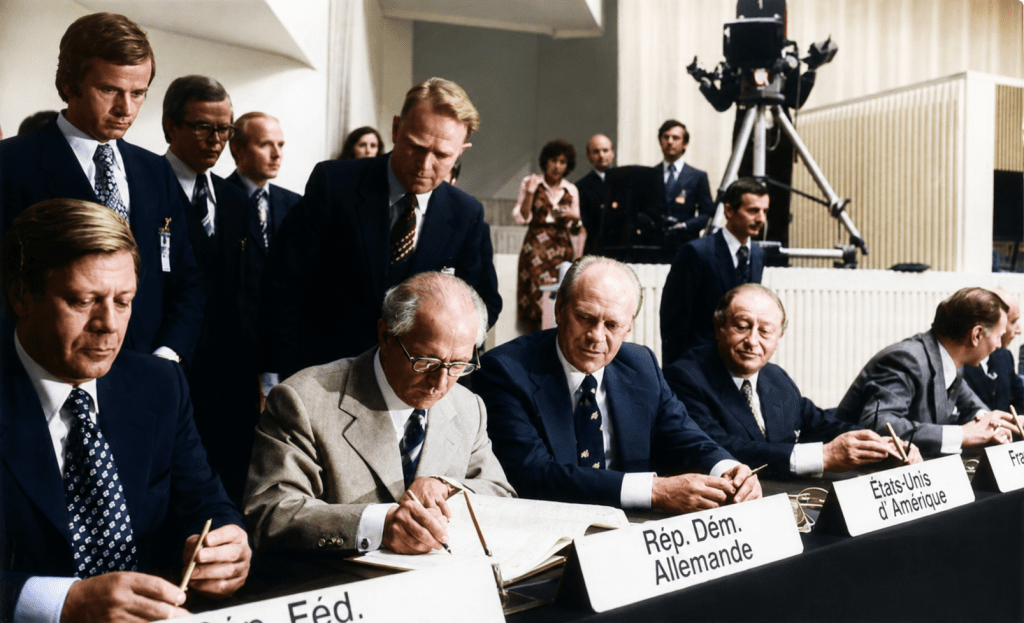
Fifty years ago, the Helsinki Declaration established the foundation for European security. It was a remarkable achievement that sealed the détente of the Cold War. It came after three years of difficult talks within the framework of the Conference on Security and Co-operation in Europe. The West and the Soviet bloc set aside their huge ideological differences and agreed upon the so-called Decalogue, a list of ten points “guiding relations between participating states”. Among these were sovereign equality, refraining from the threat or use of force, territorial integrity of states, peaceful settlement of disputes, and non-intervention in internal affairs.
Crucially, the 35 countries that participated in the Helsinki Conference introduced the principle of “indivisible security”, which implied that the security of one country should not come at the expense of the security of others. Over time, however, the West and Russia came to interpret the concept of “indivisible security” in very different ways. This became evident after the Warsaw Pact and the Soviet Union collapsed between 1989 and 1991. For the West, the principle of “indivisible security” had to be upheld alongside the principle of territorial integrity and the right of countries to choose their alliances. For Russia, indivisible security meant that NATO, perceived as an anti-Russian alliance, should not expand towards its borders.
Russian Foreign Minister Sergey Lavrov reminded America and Europe of their commitment to indivisible security in a letter published just a few weeks before the Ukraine war in February 2022. Lavrov wrote: “The Charter for European Security signed at the OSCE Summit in Istanbul in November 1999 formulated key rights and obligations of the OSCE participating States with respect to indivisibility of security. It underscored the right of each participating State to be free to choose or change its security arrangements, including treaties of alliance, as they evolve, as well as the right of each State to neutrality. The same paragraph of the Charter directly conditions those rights on the obligation of each State not to strengthen its security at the expense of the security of other States. It says further that no State, group of States, or organization can have any pre-eminent responsibility for maintaining peace and stability in the OSCE area or can consider any part of the OSCE area as its sphere of influence.”The war in Ukraine has shattered the foundations of European security. Right before the war, European leaders — French President Emmanuel Macron and German Chancellor Olaf Scholz — tried to pursue dialogue with Moscow in an attempt to persuade Russia to renounce its invasion plans. By then, however, it was too late. Russia felt rebuffed by the US refusal to commit to neutrality for Ukraine. The Russian leadership had become convinced that dialogue with Europe was unproductive, even useless, and that its security interests would not be taken seriously. Russia then announced the recognition of the Donetsk People’s Republic and the Luhansk People’s Republic as independent states, and three days later it launched its “special military operation”. Maybe it counted on a quick victory over Ukraine. Maybe it simply wanted to send a strong signal to the West: Russia was ready to intervene militarily to defend its security interests.
The Istanbul negotiations of March 2022 almost brought the war to an end. “We were already opening champagne bottles”, said Aleksey Arestovich, a former adviser to the Office of the President in Ukraine. In the end, however, Russia and Ukraine failed to reach a deal. “This war will be won on the battlefield”, said Josep Borrell, the EU foreign policy chief, in April 2022.
Europe and America had by then decided that negotiations and diplomacy with Russia were not only fruitless, but morally unacceptable. Ukraine’s military successes in the autumn of 2022, when it retook large territories in the Kharkiv and Kherson regions, convinced many that negotiations with Russia were unnecessary and that by the following spring the war would be over. For Ukraine and Western strategists, the prospect of retaking Crimea, which had been under Russian control since 2014, became a real possibility for the first time in many years.
Meanwhile, Russia’s positions hardened as well. Offended by the Western rebuff and increasingly confrontational rhetoric, Russia became uncompromising and even more determined to achieve its goals through military means. The failure of the Ukrainian counteroffensive in 2023 and Russia’s steady, though small, territorial gains in the Donbas convinced the Russian leadership that victory was inevitable and that Russia was simply militarily superior to Ukraine. The Ukraine war had entered a vicious circle of escalating rhetoric.
Enter Donald Trump. For all his flaws, the American president, re-elected in November 2024, may have had a genuine interest in putting an end to the Ukraine war. His openings towards Russia were, however, portrayed by much of the European and American establishment as “abandoning Ukraine” and acting in the interests of Putin’s Russia. Ukraine’s war had now become Europe’s war. More than a year has passed since the US and Russia started conducting negotiations on the Ukraine question. The results have been modest. Russia insists on the goals of the “special military operation” — demilitarisation, denazification, and Ukrainian neutrality. Europe, on the other hand, has picked up the burden of keeping the Ukrainian military effort afloat. Even now, it is still entertaining the possibility of negotiations with Russia while insisting that Russia must be “forced to the negotiating table” through “pressure”, meaning increased attacks on Russian territory. Europe is not functioning as a neutral mediator between Russia and Ukraine, and that is by design.
In the words of Finnish Foreign Minister Elina Valtonen: “We aim for a just and lasting peace in Ukraine. Europe needs a role at the negotiation table, but not as a neutral mediator — rather as a party with its own vested interests.” Her words were echoed by Kaja Kallas, the EU High Representative for Foreign Affairs, who said: “Europe will never be a neutral mediator between Russia and Ukraine, because we are on Ukraine’s side, and we are defending our own core security interests.” She also argued that “an unconditional ceasefire is a prerequisite for any kind of peace negotiations”. The EU is insisting on an approach that has produced very few results.
Russia is not particularly impressed by this. Calls for European rearmament have led Russia to harden its rhetoric. Many in Russia now speak of an inevitable war with NATO. NATO is confident that it would win a conventional war with Russia. Hence, Russia may be tempted to escalate quickly in an attempt to inflict major damage on Europe. Europeans, however, are convinced that this is nothing but a bluff and an exercise in Russian nuclear blackmail. The consequences of underestimating Russian determination may be fatal. Insisting that we should not fear Russia may be precisely what forces Russians to resort to extreme measures.
Breaking the Circle of Violence and Escalation
Hardliners in the West argue that peace in Europe will be possible only if Russia is defeated. Any hint of willingness to talk to Russia is labelled as “appeasement”, as if it were 1939 again. Not all wars have to be interpreted through the moral framework of the Second World War. What may once have been seen as fringe or radical voices now speak for the European mainstream. Europe’s foreign policy is increasingly influenced by countries like Lithuania, Latvia, and Estonia, driven by a long tradition of anti-Russian sentiment. The pragmatic approach once championed by France, Germany, or Italy now seems like the memory of a bygone era.
All this is not inevitable. Regardless of whether they like Russia or not, few Europeans have an appetite for a larger war on the continent. There are no strong ideological differences between Europe and Russia today. Both live in a secular, materialistic world organised according to the rules of capitalism, tempered — at least in theory and to varying degrees — by social protections and welfare mechanisms. Russia is not bent on restoring the Soviet Union as though it were driven exclusively by an unstoppable force of imperialism compelling it to expand endlessly. Until recently, Russians believed that they belonged to Europe, and Europe regarded Russia as part of the European family. Russians, like Europeans and Ukrainians, are proud people. Efforts aimed at humiliating them are bound to be counterproductive.
Fifty years ago in Helsinki, at the height of the Cold War, reason prevailed. If history is a trajectory of progress, and if we assume that people can learn from it — something that today may seem a daring and overly optimistic assumption — there are no grounds to argue that what was possible then is impossible today. Some argue that the Spirit of Helsinki is a thing of the past and that its naïveté ultimately condemned it to failure. This is false: the Helsinki Accords were grounded in realism, not idealism. The Spirit of Helsinki may be the only thing capable of pulling us back from the brink of a permanent war.


Leave a Reply