
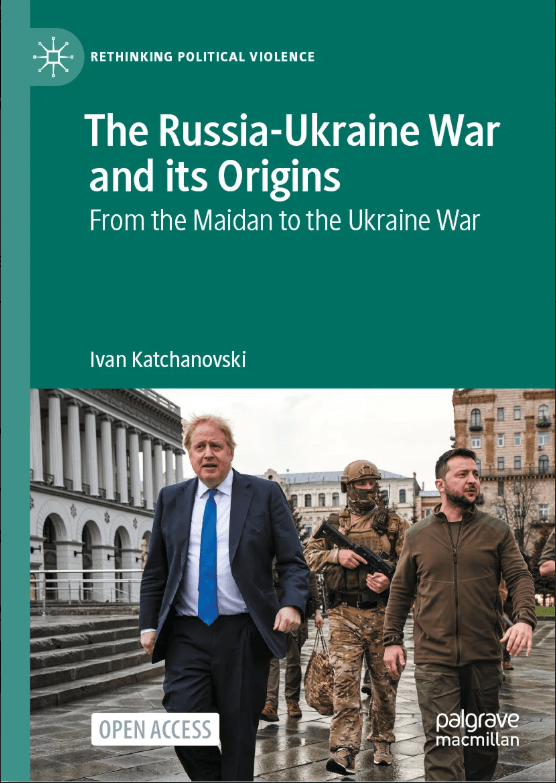
On April 28, the Ukrainian newspaper Ukrainskaya Pravda published an open letter signed by more than one hundred scholars of Eastern Europe concerning a recent book by Ivan Katchanovski, a Ukrainian professor based in Canada. The book, The Russia-Ukraine War and Its Origins: From the Maidan to the Ukraine War, questions much received wisdom about the Russia-Ukraine War, challenging widely accepted interpretations of its origins and of the political crisis that preceded it.
Rather than offering a conventional academic review, the signatories presented their intervention as a public warning. Their concern was not about factual disputes or methodological disagreements. They argue that the book advances a broader thesis in which Russia’s invasion is not primarily explained by Russian policy, but by developments inside Ukraine and the actions of Western governments. In this reading, as Katchanovski himself writes, Russian imperialism appears only as “a significant but a secondary factor.” From there, the article moves to the standard consequential claim: that such an interpretation is “often congruent to the Kremlin’s propaganda,” particularly in the way it reframes responsibility for the war. “Our statement is related not so much to the exact content of Katchanovski’s book as to the volume’s central message and its seemingly very wide reception, which is atypical for a non-fiction book under the imprint of an academic publisher”, write the authors of the text. In their view, the influence of such interpretations cannot be separated from their political consequences during an ongoing war.
East and West. Independent newspaper. Online since 2016
To help up stay independent, please consider funding
Patreon: https://www.patreon.com/posts/east-and-west-151550389
(CLICK ON LINK TO DONATE)
Go Fund Me: https://www.gofundme.com/f/east-and-west-newspaper (CLICK ON LINK TO DONATE)
You can find the latest issue of East and West below.
The controversy is closely connected to Katchanovski’s earlier research on the Maidan shootings of February 2014 in Kiev. Those events occupy a central place in the political memory of post-2014 Ukraine. The dominant interpretation, supported by official Ukrainian investigations, holds that security forces loyal to President Viktor Yanukovych were primarily responsible for the killing of protesters.
Katchanovski has long argued that the events were more complex. Drawing on video recordings, witness testimonies, ballistic evidence, and other material, he has questioned whether responsibility can be attributed so unequivocally to one side alone. In particular, he has argued that some shots may have originated from buildings under the control of Maidan protesters, including the Hotel Ukraina during the final phase of the clashes on February 20, 2014.
Among the signatories of the letter were figures such as Andreas Umland, Anders Åslund, and Andreas Kappeler. The underlying issue is larger than a disagreement over one book. Since the beginning of the large-scale Russian invasion in 2022, interpretations of recent Ukrainian history have become deeply entangled with contemporary geopolitical conflict. Questions surrounding Maidan, NATO expansion, Western policy, Ukrainian nationalism, and Russian strategy are no longer treated simply as historical subjects; they are increasingly viewed through the prism of legitimacy, responsibility, and wartime information struggles.
Katchanovski responded publicly on social media shortly after the publication of the letter. His reply rejects both the substance and the framing of the accusations. He describes the article as a coordinated attempt to discredit him rather than to engage with his research, writing that it amounts to “a smear campaign.” The opening line sets the tone: “They have no decency left.” According to his response, critics have avoided direct engagement with his empirical material and instead relied on moral and political denunciation. He portrayed the controversy as evidence of a narrowing intellectual climate in which certain interpretations become unacceptable because of their perceived political implications.
The dispute reflects two overlapping conflicts. The first concerns historical interpretation: how to understand the Maidan uprising, the collapse of Yanukovych’s government, the war in Donbas, and the chain of events that culminated in the Russian invasion of 2022. The second concerns the role of scholarship during wartime and the extent to which academic arguments should be evaluated not only on evidentiary grounds, but also according to their possible political effects.
For the signatories of the letter, narratives that redistribute responsibility for the conflict risk reinforcing geopolitical narratives favorable to Moscow. For Katchanovski and his defenders, the reaction illustrates the danger of turning historical inquiry into a domain regulated by political loyalty and wartime consensus.
As long as the war continues, debates over its origins are likely to remain intensely politicized. The boundary between historical analysis, public discourse, and geopolitical conflict has become increasingly difficult to separate, particularly when interpretations of the past are immediately drawn into contemporary struggles over legitimacy and international opinion.


Leave a Reply