
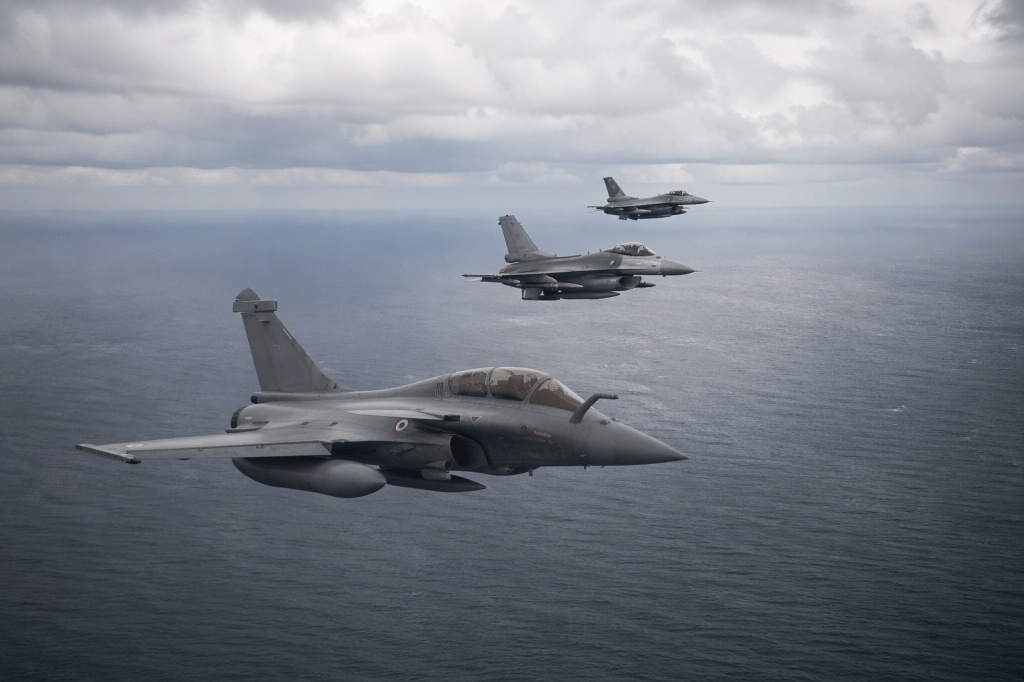
On April 23 and 24, France and Poland simulated nuclear strikes on targets in Russia and in Belarus in joint military exercises. Polish F-16s were tasked with long-range reconnaissance and target designation, including simulated cruise missile strikes with JASSM-ER systems toward high-value objectives in the Saint Petersburg area, while French Dassault Rafale B aircraft—equipped with ASMP nuclear cruise missiles—simulated the nuclear strike phase itself
The prospect of extending France’s nuclear deterrence to Poland marks a consequential shift in European security. Joint Franco-Polish military exercises involving nuclear-capable systems have triggered a lot of political signaling, and strategic ambiguity.
Following high-level political contacts between Emmanuel Macron and Donald Tusk in April 2026, defense cooperation between Paris and Warsaw has moved into a more operational phase. At the core of this development are joint air exercises over northern Poland and the Baltic region. These exercises involve French aircraft such as the Rafale, capable of carrying nuclear-armed ASMP cruise missiles.
For now there is no indication of permanent nuclear deployment on Polish territory. Instead, French nuclear-capable systems would appear only temporarily, in the context of exercises or rotational presence.
The logic behind this cooperation lies in deterrence—specifically, the signaling of credible military response options. France possesses an independent nuclear arsenal, including air-launched systems and submarine-based missiles. Estimates suggest dozens of ASMP missiles are available for airborne deployment.
In the proposed framework, Polish forces would not control or deploy nuclear weapons. Their role would instead focus on reconnaissance, target identification, and conventional support operations. Decision-making authority would remain strictly national: any use of nuclear weapons would be authorized solely by the French president. Unlike NATO’s “nuclear sharing” arrangements, France does not transfer operational control or co-ownership of its arsenal.
For decades, nuclear deterrence in Europe has relied primarily on the United States through NATO structures. The French proposal does not seek to replace this framework but to complement it.
French officials have framed their approach as an additional layer of security for European allies, particularly those on NATO’s eastern flank. At the same time, the initiative reflects a long-standing French ambition: to position itself as a central actor in European defense, especially in areas where the European Union lacks unified capabilities.
Yet ambiguity persists. Some analysts emphasize that the French offer does not constitute a formal “nuclear umbrella” in the American sense. There is no automatic guarantee, no shared command structure, and no institutionalized burden-sharing.
Instead, what is emerging is a hybrid model—part political signal, part military coordination, part strategic experimentation.
Strategic signaling toward the East
The timing of these developments is not accidental. The exercises and discussions are widely interpreted as a response to the deteriorating security environment in Eastern Europe, particularly tensions involving Russia.
From this perspective, the presence—even temporary—of nuclear-capable French aircraft in Polish airspace serves a symbolic function. It signals that deterrence is not confined to distant strategic assets but can be projected closer to potential theaters of conflict.
However, such signaling is inherently double-edged. While intended to reinforce stability through deterrence, it may also contribute to escalation dynamics or reciprocal military posturing.
Despite the political attention, several constraints shape the practical impact of this initiative. First, the absence of permanent deployment limits its operational immediacy. Rotational presence and exercises enhance readiness but do not fundamentally alter the balance of forces.
Second, the centralized nature of French nuclear decision-making introduces uncertainty. Unlike NATO’s collective structures, the French system ultimately depends on national judgment, which may or may not align with allied expectations in a crisis.
Third, the initiative remains in an exploratory phase. Many details—frequency of deployments, scope of exercises, long-term commitments—are still undefined.


Leave a Reply